

Settings
Profile, sign-in and security, email preferences, drive sharing, and the organization policies an admin controls.
Settings is reachable by every signed-in user. It holds your personal account controls and, if you administer an organization, the policies that apply to everyone in it.
The tabs
| Tab | Who sees it | What it holds |
|---|---|---|
| Overview | Everyone | Account status, plan, credit usage, and a shortcut to manage the plan |
| Profile | Everyone | Display name and how you appear in BriefCatch |
| Sign-in & Security | Everyone | Password and sign-in method, including which provider you signed in with |
| Email preferences | Everyone | Which BriefCatch emails you receive |
| Drive Sharing | Organization admins | Whether members may connect personal drives, and which shared drive the organization exposes |
| Members | Organization admins | Invitations, roles, and membership — see Teams and organizations |
Personal drive connections live on the Integrations page in the left navigation, not here. This tab is the organization policy for drives; that page is where you actually connect one. See Integrations.
Profile
Your display name is how you appear to other people in your organization — in the member list, on shared documents, and in audit trails. Changes save immediately and the page tells you when they have.
Sign-in and security
Account security actions stay inside BriefCatch’s identity flow. If you signed in through Google or Microsoft, the page says so, and your password is managed by that provider rather than by BriefCatch.
BriefCatch documentation and support will never ask you to paste a password or an access token. Treat any message that does as an attack, whatever it appears to be from.
Email preferences
These control the customer emails BriefCatch sends you — product and lifecycle messages. They are separate from the in-product notification feed, which is not an email channel and is not turned off here.
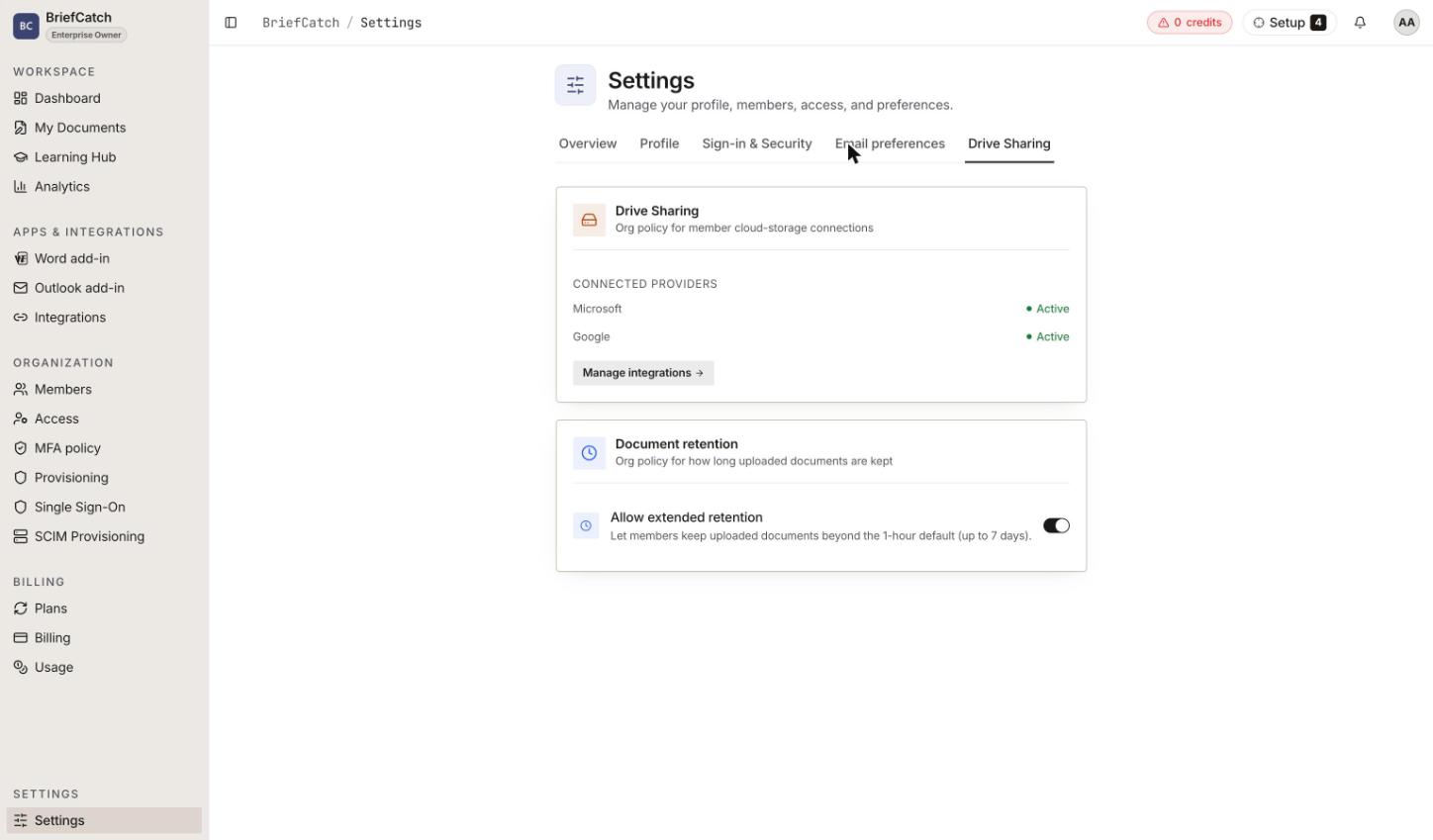
Organization policies
Two admin controls have consequences for every member, so they are worth stating plainly:
Allow personal drives
Whether members may connect their own Google Drive or OneDrive. Turning this off removes a route documents can take out of the organization’s control.
Document retention
The organization’s policy for how long uploaded documents are kept. It sets the ceiling members can choose from at upload.
Share a drive with your organization exposes one shared drive to every member, who can then browse it from My Documents. Members are pinned to the drive root you designate — that scoping is enforced by the server, not just hidden in the interface. Turning sharing off removes the organization drive from My Documents for everyone.
An auto-join domain policy, where configured, decides whether someone signing up with your organization’s email domain joins automatically or waits for an invitation.
Word add-in preferences
The add-in carries its own preferences, set inside Word rather than here:
- Real-time updates refresh suggestions and reports as the document changes. Unavailable in Office Online and Outlook — use Refresh there instead.
- Inline suggestions underline flagged text in color; selecting an underline opens the related card. Unavailable in Outlook.
- Preferred view and the AI controls appear only when enabled for your account.
The add-in also links to your account and subscription. Those links open the web portal and stay subject to your role, so an admin following a billing link still lands on the owner-only wall.